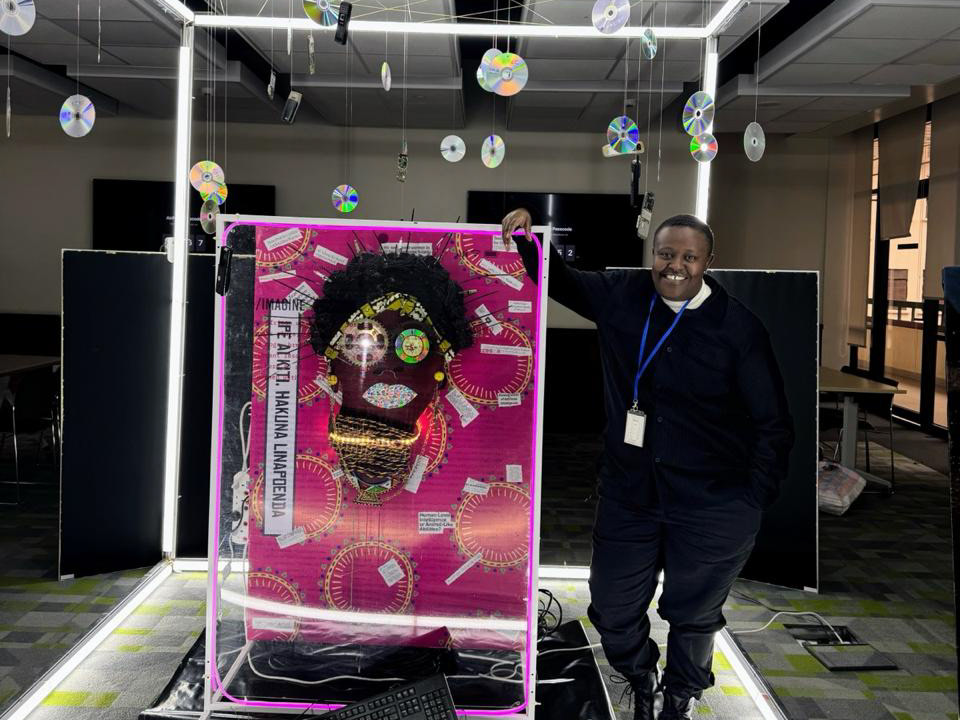
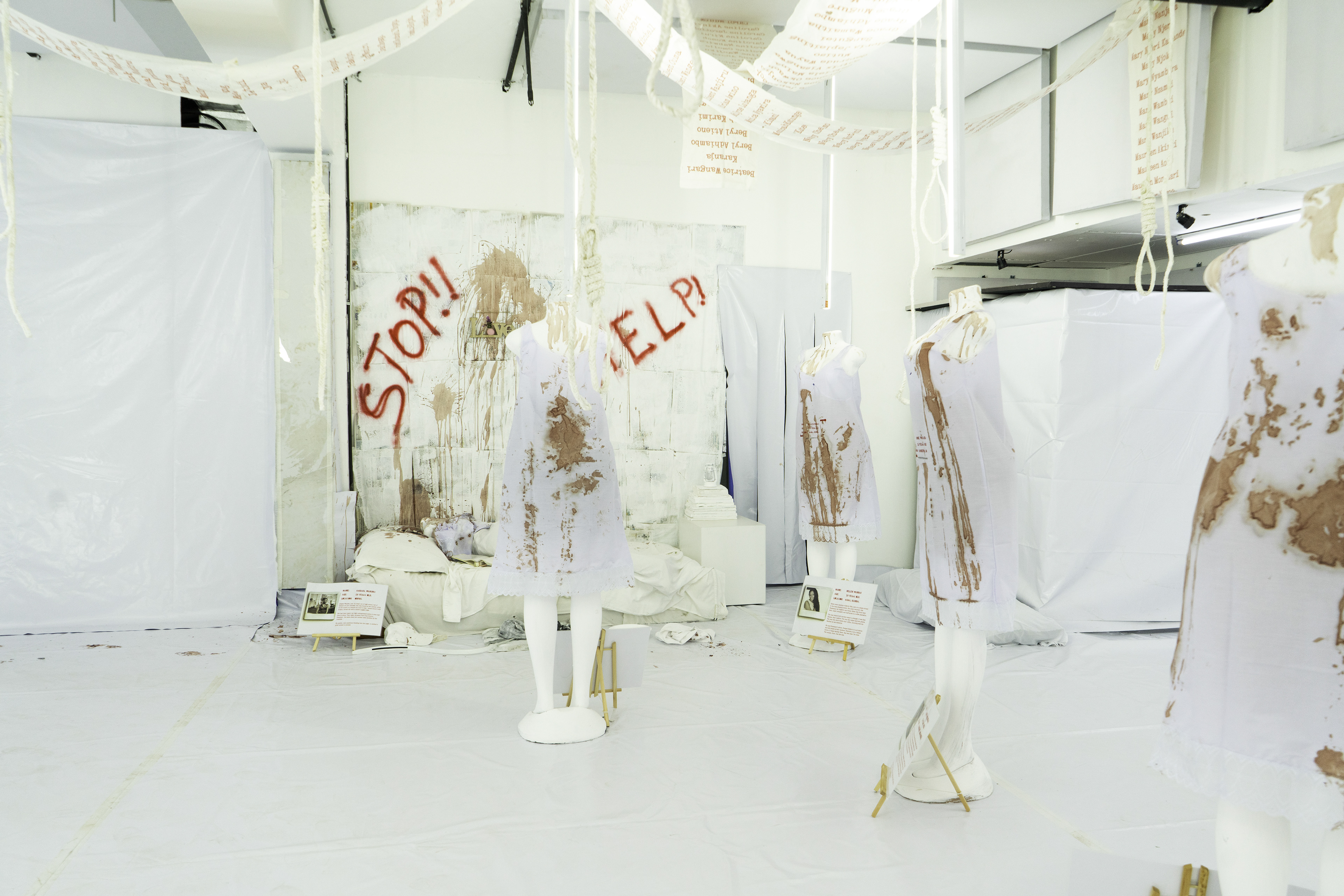
In August 2025, I had the absolute honour of piecing together an installation Art called Maskan after my good friend Njeri Migwi from Usikimye asked me to create an exhibition around femicide. Maskan is an immersive, multi-sensory art installation that confronts the rising femicide crisis in Kenya.
Designed to be experienced as both a house of mourning and a space for collective
witnessing, each installation piece takes you deeper into the emotional, political, and personal layers of what it means to lose a life to femicide.
The space is whitewashed and sterilized, a deliberate visual metaphor that runs through the installation’s architecture. The whiteness represents absence. A blank canvas that echoes erasure. It represents the way society washes over the violence, silences the names, and forgets the faces. The stark, clinical sterility mirrors the bureaucratic coldness with which so many femicide cases are handled, where victims are reduced to case numbers and justice is a stalled process.
However, this silence is interrupted. Splashes of blood rupture the whiteness. They are not decorative. They are not symbolic. They are reminders. Reminders that these are not abstract losses. We lost lives. Real women. Real futures. Real stories.
The contrast between the clean, muted environment and the visceral stains forces a confrontation between what we choose to forget, and what refuses to be forgotten. The blood interrupts the erasure. It makes the violence visible again. It insists that we do not walk through this space untouched.
Artist Statement
Maskan began with a question: What happens when home, the one place meant to hold and protect you, becomes the very site of your erasure?In Swahili, MASKAN means home. In Arabic, it shares roots with stillness, rest, and habitation. Today, Kenya, home has become dangerous terrain for far too many women and girls. Behind closed doors, within familiar walls, safety slips away. Lives are taken and silence lingers longer than it should. This work is a refusal to look away.As an artist, I am drawn to memory, not the sanitized kind, but the messy, raw kind. The kind that lives in fabric, in smell, in silence, in half-sent texts and grieving mothers’ wails. MASKAN is built from that memory. It’s a house haunted not by names we once knew. I wanted to humanize the women we’ve lost. To remind us that they were here; wearing clothes, sending messages, making dinner, loving people, dreaming about tomorrow. I wanted to hold space for those who remain, carrying unbearable grief and unheard rage.
1. The Threshold of Awareness
Before you step into the heart of MASKAN, you are met with a short, atmospheric visual, artistic prelude designed to stir the senses and quiet the noise of the outside world. This opening piece is a portal. A soft yet unsettling descent into the lived reality of femicide in Kenya. Through abstract imagery and fragmented narrative, the visual experience begins to peel away the protective layers of denial, distance, numbness. Here, grief begins to whisper. As the doors open, you are no longer a visitor. You are a witness entering a house where every corner remembers.
2. 129 Steps Stolen
At the centre of the space stands a towering installation of 129 women’s shoes, representing a woman who was killed by femicide in Kenya between January and March 2025. Three months. 129 lives. One national crisis. These shoes once meant movement; to work, to school, to joy, to prayer, to love. Shoes are deeply personal; they carry the shape of a body and the weight of a life yet here, they carry the heaviness of absence. Each pair tells a story of interrupted journeys. Of voices silenced. Of steps never taken again.
3. Unchecked in the Comments
Lining this wall are screenshots of real social media comments that are raw, unfiltered, and unapologetically visible. These are not imagined insults. These are not distant voices. These are the actual words of people who walk among us; neighbours, colleagues, classmates, friends.
Each comment mocks, blames, dismisses, or justifies femicide. Their cruelty is casual. Their tone often joking. Their anonymity emboldens them and their boldness reveals the deep rot of a society where gender-based violence is not just committed, but normalized. We chose not to blur their names because silence protects the abuser. Anonymity shields the enabler and erasure excuses the violence. This wall is a mirror that forces us to confront the bystander culture where violence is laughed at in the comments, then forgotten by morning. Let this disturb you because that discomfort is the first crack in denial.
4. Where Rest Becomes Final
This is a space that should have soft pillows folded sheets and the illusion of peace. Yet this has become a place of betrayal. Most femicides in Kenya do not happen in dark alleys or public spaces. They happen behind closed doors, in homes and often, they are committed by a partner, a husband, a boyfriend, who was meant to love, protect, and cherish the victim.
5. Mannequins of Memory
Each mannequin carries the story of a woman killed by femicide in 2025. They are dressed in white petticoats, traditionally garments worn closest to the skin; intimate, delicate, unseen. Here, they are brought into full view. Each petticoat is stained with blood, a reminder that violence entered the most private spaces. That safety was stripped away. That even the most personal layers were not spared. The victims’ names are printed in red, etched directly onto the fabric. Red for blood. Red for memory. Red because we will not forget.
6. The Echo Chamber of Emergency
This audio installation features re-enacted distress calls based on real emergencies received daily by Usikimye, an organization on the front line of responding to gender-based violence in Kenya.
Each voice represents a life at risk, a moment of desperation, of not knowing whether help will come in time. The booth compresses space and sound to mimic the claustrophobia of crisis. There is no escape. Just the weight of voice after voice after voice.
For the Usikimye team, this is their daily reality. The Echo Chamber of Emergency offers only a glimpse of the volume, fear, and urgency they navigate day after day, call after call. As you leave the booth, ask yourself: What does it mean to be the one on the other end of the line? And more importantly; what does it mean to live in a society where these calls never seem to end.
7. Buried Futures
A soft sandpit, scattered with small toys, socks and half-buried storybooks, but here, play is not possible because joy has been silenced. This installation is a quiet, devastating tribute to the children affected by femicide; the silent witnesses, the grieving orphans, and the little ones whose own lives were taken too soon, caught in the crossfire of violence or deliberately erased alongside their mothers.
Some of these children watched it happen. Some ran. Some screamed. Some stayed frozen in the next room and thers never got the chance to grow old enough to remember. The sandpit holds their absence. Each grain, a memory not made. Each toy, a dream unfulfilled. Each small shoe, a journey that never began.
8. When Death Becomes a Headline
This short film is intercut with headline after headline announcing yet another woman lost to femicide. Through this loop, the installation reflects a painful truth: We have become desensitized. Femicide is no longer breaking news. It is background noise. A ticker at the bottom of the screen. A story you scroll past at breakfast.
9. The Final Breath
This screen holds a series of a haunting imagining of what the victims of femicide might have said in their final moments. We do not know their exact words but we can imagine the fear, the pleading and the silence that follows. These words are meant to humanize and restore agency. To fill in the void that violence left behind.
10. Names of Resistance
This screen displays a visual roll of over 100,000 names, individuals from across Kenya and beyond who signed the petition demanding that femicide be declared a crime in Kenya. One name after another of someone who chose to speak out. Someone who said, Not one more. Someone who refused to stay silent.
Together, these names are a digital monument to the power of collective voice. As the screen continues, it becomes clear: this is not just a list, it is a refusal to look away. This is what solidarity looks like, name by name.
11. Stains That Won’t Wash Out
A line of white garments stretches across the space; delicate, familiar, almost domestic but each one is stained. Marked. Irrevocably altered. They are visual metaphors for the women whose lives were touched by violence. Stained not by their choices, but by the brutality of those who harmed them. Stained by the hands of partners, lovers, family members, people who should have offered care, but instead inflicted pain.
The garments flutter lightly as if still holding the presence of the women who once wore them. Yet the stains remind us that these clothes cannot be washed clean because the stain is not only on fabric; It is on our society. On our systems. On our silence.
12. Where Cases Go to Die
This corner of the installation is a stark, sobering representation of the justice system’s failure in responding to femicide. A desk piled with dust-covered case files are a quiet symbol of inaction. It’s not just about bureaucracy. It’s about abandonment.
Justice in Kenya, for many women, is not just delayed. It is denied or worse it simply disappears. This space forces us to confront what happens after the funeral, when the cameras leave, the hashtags fade and the victims families are left alone to fight a system that was never built for them.
13. The Moment Everything Changed
A wall of stopped clocks marks the moment when life was violently interrupted. For each victim, there was a time, a specific hour, a final minute when everything stopped. The breath. The heartbeat. The possibility of a future. The clock didn’t just stop for them. It stopped for their mothers. For their children. For their friends, siblings, entire families now frozen in a grief that moves with them every day.
This installation is a quiet meditation on sudden absence. The clocks are no longer ticking. The seconds no longer pass, yet, the pain keeps echoing, reminding us that while the world moves on, for those left behind, time has not resumed. The still hands of each clock become a symbol of unfinished conversations, birthdays that will never come, and stories that ended mid-sentence.
14. A Sky of Loss
High above, suspended from the ceiling, a long white scarf stretches across the room, printed along its length are the names of women and girls whose lives were violently cut short. Each name a story. Each thread a life interrupted. The scarf wraps the room. It becomes a canopy of remembrance, hanging over us like memory itself bearing the weight of immense loss.
As you look up, you are invited to feel small beneath it. To imagine what it means to live in a country where names like these keep growing. To recognize that while we often bury our dead, here, we raise them into a sky that refuses to forget.
15. The Shadow That Remains
The noose not only represents the brutal means through which life is taken, but also the emptiness left behind. The space within it is an unsettling absence that stretches across the room like a held breath. It marks the site where something unthinkable happened, and nothing will ever truly fill the void.
Suspended above, a noose hangs in stillness, heavy with implication, haunting in its silence. A stark reminder of the moment after violence, when the act is done, the body removed, and yet the space remains haunted. The air does not forget. The silence is not innocent. The noose forces us to confront the uncomfortable truth that femicide does not only destroy lives, it destroys presence. It leaves families broken, rooms quieter and communities fractured.
16. Where Silence Rests
The Grave is a symbolic resting place, quiet and unadorned, yet heavy with meaning. Here, we lay down the weight of all we’ve witnessed. We honour the women and children whose lives were stolen. We mourn what was lost; lives, futures, dreams, laughter, love.
This space is still. It is a sacred pause, a moment to sit with the grief and to feel it fully. This is a space for collective mourning, for reflection, for remembrance. A place to say goodbye to names you may have never known, but will now never forget.
17. Reflection of thoughts
This is a space for stillness. For breath. For reckoning. Here, we invite you to pause, write, and reflect. Maskan is about naming, remembering and maybe, beginning again, this time, less silent.
Installation Title: MASKAN
Produced by: Usikimye & Creatives Garage
Curated by: Thayù
Installation Design: Thayù
Visual Editor: Lawrence Gichu
Installation Assitants: Steve Collins, Njoki Kimwaki
Sound Design: Thayù
Sound Design: Thayù
Text & Narrative Writing: Thayù with contributions from the Usikimye and Creatives Garage teams
Design & Layout (Catalog): Thayù
Special Thanks to all the survivors, families, supporters, and every
voice that refuses to be silenced.In memory of the women and children we have lost to femicide in Kenya.
voice that refuses to be silenced.In memory of the women and children we have lost to femicide in Kenya.